
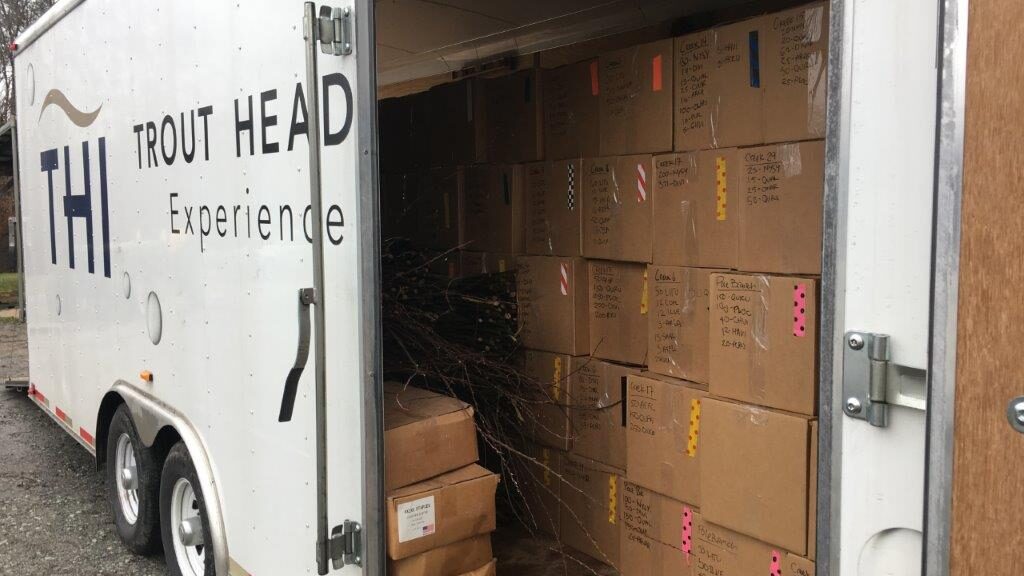
Trailer loads of commercial plants, carefully sourced and specified, go into most Trout Headwaters projects. The company has been responsible for planting millions of native trees and shrubs across the U.S.
A recently released study tells us that one of the most effective strategy for controlling invasive plant species is to transplant plant native species into infested areas. Many management plans today are focused on restoration of native plant communities with invasives controls considered a part of the larger effort. It has been long understood that disturbed, damaged or overgrazed soils are rich ground for the least desirable and most invasive plants.
In a recent 2021 study, Invasive Species Research in Non-tidal Compensatory Mitigation, researchers DeBerry and Hunter list their top recommendations for managing invasive species as ‘plant, plant, plant, and plant’. Specifically, the study identifies these top four ways to battle plant invaders:
“Best Practice #1: Plant larger trees. Planting trees from larger stock types would promote
canopy development and hasten canopy cover, a factor that ended up being an important
environmental driver across the invasion gradient in all data sets. To address expense,
alternative vegetation performance standard like Stem Area at Groundline (SAG) could be
used instead of density, allowing larger stock to be incorporated in a planting plan without
undue expense.
Best Practice #2: Plant trees at a higher density. A higher density of young trees could
achieve the same results as #1 above at a reduced cost. To address the higher risk of
mortality using small stock sizes, trees should be sufficiently hardened by the grower and
planted while dormant in the fall if possible.
Best Practice #3: Plant early successional trees. Early successional species are fastgrowing, more likely to facilitate canopy closure, and can function as a nurse crop for late
successional species on mitigation sites. Planting early successional trees can increase the
survivability of late successional trees while reducing risk of invasion through canopy
development.
Best Practice #4: Plant a diverse seed mix at a high application rate. A diverse seed mix
with high percentage of rapid-germinating annuals combined with high species richness of
perennials and tree seed will maximize potential for rapid germination and ecosystem
resiliency, advantaging native species via competitive benefits promoted by early
establishment.”
See the full study here https://resourceprotectiongroup.org/wp-content/uploads/2021/03/DeBerry-and-Hunter-2021-Invasive-Spp-Research-in-Nontidal-Mitigation-FINAL-REPORT-3-22-21.pdf


