
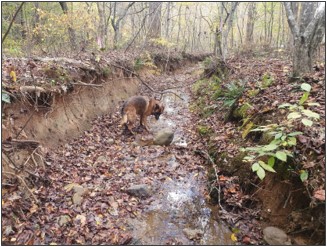
Deep, historically ditched and degrading


Following a simple stream channel classification/restoration ‘cookbook’ is no recipe for the successful restoration of our watersheds. Among other things, the ‘rechannelization’ approach often lacks a basic, vital respect for the habitats and resources we in the restoration industry should be working to preserve, restore and maintain. Some of it stems from engineers or hydrologists muddling together two distinctly different concepts – “natural channel design” and “stream restoration.” Whether misunderstanding, or lack of experience, or something else, the failed projects are often expensive environmental ‘mistakes’.
Trout Headwaters follows a solid, simple credo for stream restoration; “first, do no harm.”
We do not dredge and fill to force channels into a particular geometry. New channel construction is always a last resort owing to cost, risk, and invasiveness. It is never a first or second choice. We promote a broad palette of low-cost, sustainable strategies. We design restoration projects to eliminate/reduce the effects of human-caused disturbance, to improve water quality, and to enhance biodiversity. We work to develop wide, lush floodplains and riparian buffers that filter and store runoff and floodwater, provide habitat, and serve as food sources for fish and wildlife.
These restored systems, with ongoing adaptive management, become more diverse and more fully functional over time.
Trout Headwaters recognizes the near impossibility, due to centuries of human impact and development, of restoring most streams to their Holocene-era marshy, multi-channel morphology. What we can do, however, is limit further floodplain development, restore denuded riparian buffers, continue promoting good management and restoration practices, and follow good science.
Most importantly, we can and should understand that nature has a great capacity to restore herself when given just half a chance.


