
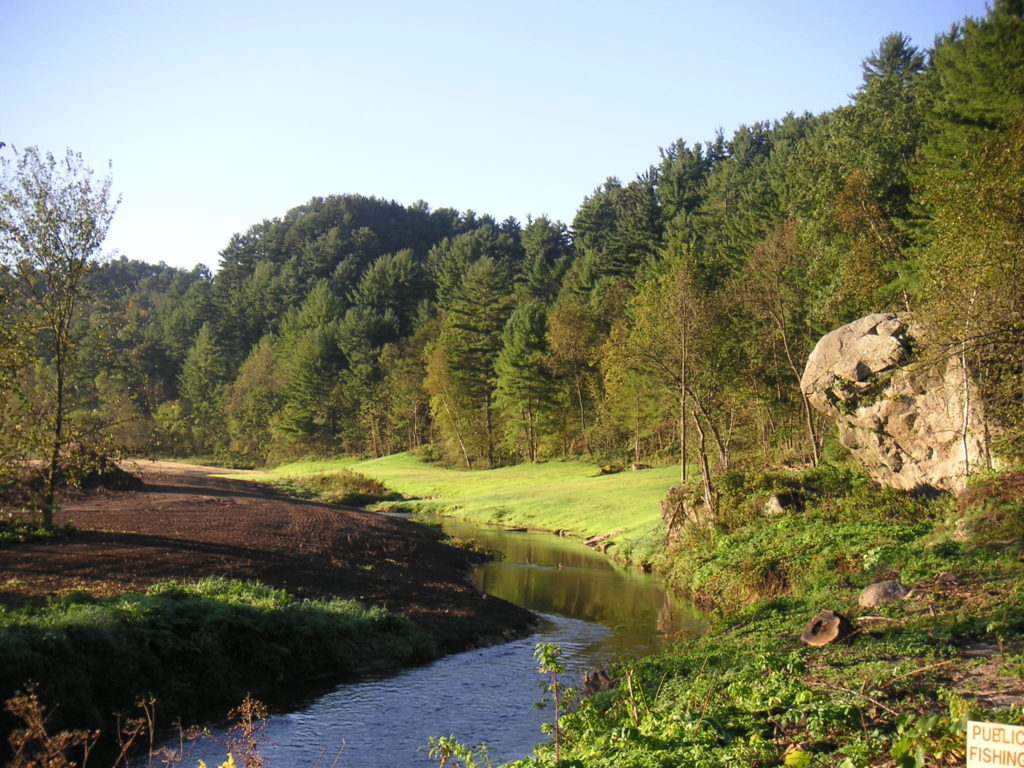
A newsletter from Iowa recently touted some “Top Trout Fishing Destinations”. In the list was Patterson Creek in Allamakee County because “beginners can cast freely without getting hung up in trees or overhanging vegetation thanks to in-stream habitat and bank stabilization habitat improvements.”
Unfortunately, while replacing pesky stream-side trees and bushes with grass may create an easy learning environment for beginning anglers, it does not improve the ecosystem or biodiversity along the stream. It also does not provide the beginner with the knowledge of what comprises a healthy trout stream.
Properly vegetated riparian buffers provide important stream functions including sediment trapping, nutrient cycling, stream shading, energy dissipation, natural moderation of floods, improved bank stability, natural wetland development, and delivery of organic matter to the stream. Revegetating stream buffers with native woody and herbaceous vegetation offers cover to fish, slows the velocity of the stream during flood events, stabilizes stream banks, and provides valuable stream-side habitats for birds and other animals.
Regrettably, stream banks with only putting green-like grass do not constitute healthy functioning riparian buffers or ‘restoration’. Activities that cause denuding of the buffers are not considered restorative, rather these practices constitute habitat destruction.
Read more at: http://www.mvr.usace.army.mil/Portals/48/docs/regulatory/ISMM13July2017.pdf


